Images of the Yoni and Visualizing Pregnancy, Birth, and Creation
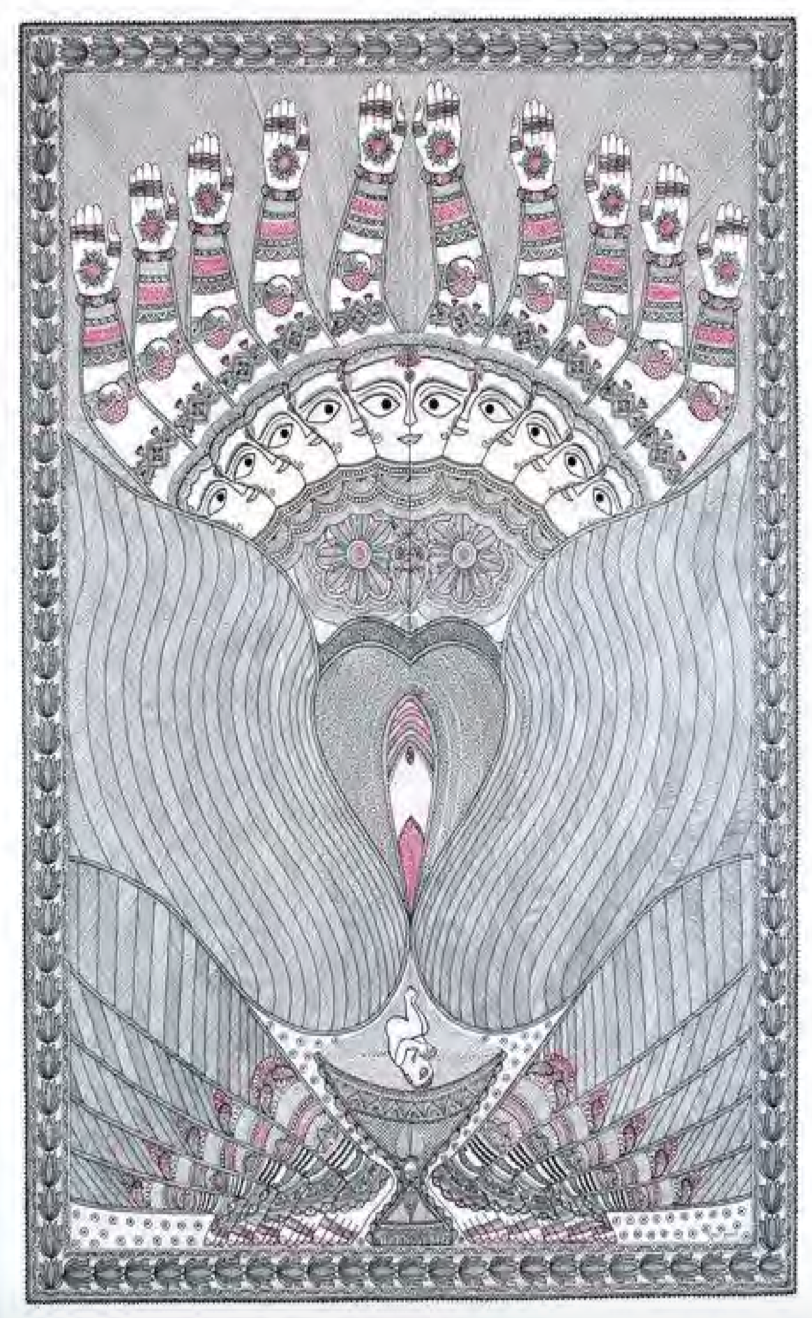
A Madhubani image of Yoni (from the Delhi Crafts Museum)
Ten years ago, we wrote about Matrika Art and the Visualization of Birth on the Visualizing Birth website. In that post, we discussed the work of Janet Chawla, who has lived and worked in India now for over 40 years and has a research background in birth, midwifery, and ritual. In her book, Towards a Female Shastra, Chawla presents her research on women centered rites in India, often including powerful images that accompany the rites or are related to them. One of those images is the Madhubani image of the Yoni from the Delhi Crafts Museum shown above.
Chawla describes the complexity of what the yoni is and it’s relationship to birth and the womb, explaining that the yoni is not simply an anatomical representation of a female body part:
Currently the vagina, the entry to the womb, is most often represented in dry, schematic biomedical terms, or in gross, often exploitative pornography. We find completely different representational perspectives in Indian traditions. The root of yoni is the Sanskrit word yuj meaning ‘to unite.’ The yoni is the crucible where things are combined (male and female, mother and fetus) where creation and re-creation takes place. Where unseen human life (not perceptible to the senses other than the mother’s internal sensations—at least before sonograms) takes material form.
We have a desire for precision in words, in naming, especially in body parts, with our orientation towards material reality. We want to know precisely what is the definition of yoni in anatomical terms. But an answer to that question is difficult. Yoni is not a direct equivalent of vagina, nor to womb. A direct correlation between western-derived ‘anatomy’ and indigenous body knowledge is problematic, if not impossible.
The yoni is a sacred site on the female body, capable of creation and recreation. In the Madhubani image shown here, a fetus is seen nurtured deep within the womb, protected through the site of the yoni, which includes the vagina and vulva. For those who are pregnant, an image such as this one is both empowering and spiritual, reminding viewers that their bodies protect and nurture the fetus. The colors of this particular image, which are soft, with light pinks, blues, grays and charcoals, are soothing to look at.
Chawla’s website, Matrika: Motherhood & Traditional Resources Information Knowledge & Action provides visitors with a wealth of information about birth, ritual, and midwifery in India, and includes a video on Cosmic Bodies. Chawla may be reached through her Contact Page.